
Issue One · 11 October 2026
In this issue
- From the Room · Two towns
- The Report · Show us who owns you
- The Argument · A machine that writes, filed as a machine that finds
- Worth Your Attention · Schools, books, false news, cinema, what people think, work
- The Calendar · The next fortnight
- One Question · Search engine or machine?
From the Room
Two towns
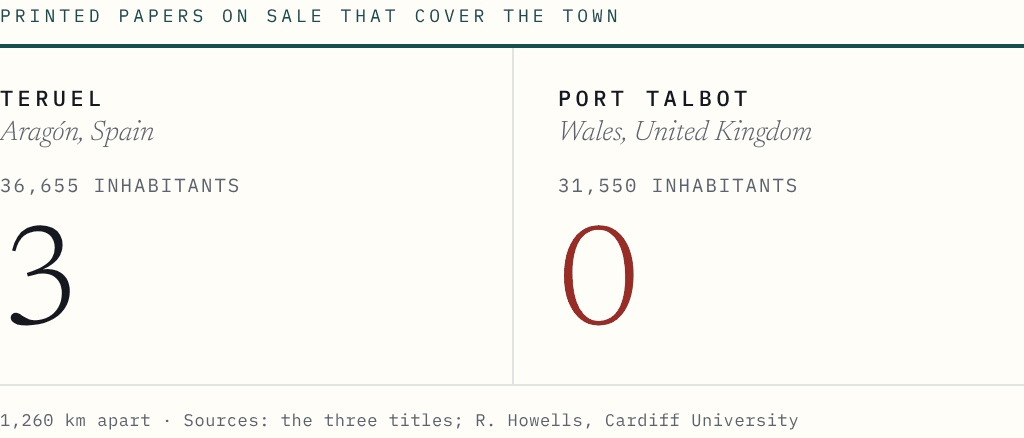
On the square at the centre of Teruel, the smallest provincial capital in Spain, the one everybody calls the Plaza del Torico after the very small bull on its column, there is a newsstand. Anybody who lives here can buy three printed papers that report on where they live: the Diario de Teruel, the daily of the province, first published in 1885 and still written in the town, and the two Aragonese dailies, the Heraldo de Aragón and El Periódico de Aragón, each with its own provincial pages. There is also the Eco de Teruel: eight journalists producing high-quality local news online.
In Port Talbot, a steel town on the south coast of Wales of a comparable size, there is no longer a single local newspaper. Rachel Howells, who worked there as a reporter until 2008, describes how the Port Talbot Guardian died slowly, piece by piece. First, around 2000, the publisher closed the newsroom in the town, taking the journalists away from the place they were there to report. Then came the staff cuts: in 2008 Howells lost her own job, and the year after that the paper stopped publishing for good. Some of the journalists left without work tried to fill the gap by founding a co-operative, the Port Talbot Magnet, which published news online from 2009 and from 2013 delivered a free monthly to 20,000 homes. That ended too, and by 2015 the stories produced about the place had fallen by two thirds, with no journalist left living in the town.
Democratic participation in Port Talbot changed alongside it. Until 1999 turnout at local elections ran 2.45 percentage points above the British average; since 2004 it has run 0.72 points below it.
Turnout in Teruel, by contrast, goes the other way. At the general election of 2023 the province voted at 71.99 per cent against a national 66.59, and the gap is widening. Where public argument is alive and the news is in good health, participation rises.
How many have gone
Local newspapers are closing everywhere. About 3,500 have gone in the United States since 2005, nearly four in ten of those that existed, and 213 counties now have no source of local news at all. In the same years at least 293 British titles have closed, one every 25 days for 20 years.
The Spanish case
Spain holds. It is the country where local and regional news is trusted by more people than any other kind, 54 per cent against 45 for news brands as a whole, and rising. The comarcal press of Catalonia, the papers of the counties, has gained readers, and the Spanish publishers’ association calls its regional press a silent fortress. Why it holds is not well understood, but it should be analyzed: Spain is the one place in Europe where a living local press can still be studied while it works.
The Report
Show us who owns you
How a newspaper dies
Information dies where there is no pluralism, no autonomy and no freedom. It dies the same way in a small local paper and in a large group, and the reasons are always several and tangled.
The first has a name: capture. A family sells to a group, the group sells to a fund, a large publisher absorbs the small independent that could no longer carry its costs, a proprietor arrives who wanted the influence and not the business. Each step is lawful, and none breaks a rule of competition: what falls is not the number of companies, it is the number of voices.
The second is political interference, which grows every year and almost never takes the form of a ban. A government does not always dismiss the editor of the state broadcaster; it appoints the board that will. It does not fine the critic; it moves its advertising and waits. Where a country has swapped the licence fee, the charge households pay for public broadcasting, for a line in the state budget, public funding has fallen by about 9 per cent; where the fee was reformed, it rose by 14. A government that wants a quieter broadcaster no longer touches the newsroom. It changes how the newsroom is paid.
What the Council of Europe voted
On 30 September the Parliamentary Assembly adopted two texts on a report I had spent two years writing, after hearing journalists and their associations across Europe: a resolution addressed to the 46 member states, and a recommendation addressed to the Committee of Ministers, which is their governments sitting together. They hold four things together: the editorial control political and economic actors are taking of the media, the pressure on public broadcasting, the spread of news deserts, and the market power of the platforms. The resolution passed by 103 votes to 6.
What the resolution asks states for is unglamorous: a regulator with a real duty to monitor pluralism, the repeal of the criminal defamation and fake-news provisions used to frighten reporters, public broadcasting whose money is out of reach of the government of the day. Eighteen European states cannot even ask what a merger between two media companies does to pluralism, although the European Media Freedom Act, in force since last year, requires them to have a way.
The recommendation, on its side, asks the Committee of Ministers for one thing: a pan-European database of who owns the media. Nobody anywhere publishes that in a form a citizen could read. Of everything in the two texts, it is the line I would keep if I could keep one.
The rest is 20 requests to 46 governments, and they come to one sentence: show us who owns you, who pays you, and who you sued last year.
The Argument
A machine that writes, filed as a machine that finds
Under the EU’s Digital Services Act, online search engines with more than 45 million monthly users face especially strict rules. ChatGPT Search reached 159 million monthly users in the EU. On 31 August, the European Commission classified it as a “very large online search engine,” giving OpenAI until January 2027 to meet the requirements. Most reports focused on the extra paperwork. But the bigger story is the classification itself: Europe has decided to treat an AI system that generates answers as a search engine.
That classification changes what regulators examine. The EU’s AI Act focuses on the technology behind AI, including training data and transparency. The Digital Services Act looks instead at its impact on society. OpenAI must regularly assess potential risks to public debate, elections and children, take steps to reduce them, undergo independent audits and give vetted researchers access to relevant data. The Commission can supervise compliance directly and impose fines of up to six per cent of global annual turnover. This is about public accountability, not just technical safety.
Those who say the public has already decided
People are leaving search. They no longer type words into a box and pick among ten links; they ask a question and are handed an answer, 159 million times a month in Europe alone. A category in law should describe what a thing does, not the shape it had when the law was written. If the public has moved its searching to a machine that writes, the obligations should move with it.
Those who say it is a different creature
Composing is not indexing. A search engine points at what somebody else wrote; this one weighs, selects and writes something new, and a rule made for indexes describes it badly. The test also proves too much: make browsing the criterion and every product with a window on the web becomes a search engine. And it falls unequally, since Gemini, Perplexity and Claude do the same thing below the threshold and carry none of it.
The first view is the Commission’s. The second comes from lawyers and from the free market institutes in Brussels, and not from OpenAI, which has not objected. Either way something has been conceded. To call an answer engine a search engine is to say that it performs an editorial act: it selects, it ranks, it presents. And once that is said, the question the law puts to the company is no longer only about copyright, where it has been stuck for three years, but about pluralism, asked differently: whether serious journalism can still be found when the answer arrives without a page.
Worth Your Attention
Schools
The largest school system in America has pulled back. From this autumn New York City bars student-facing generative artificial intelligence, chatbots and AI tutors alike, from pre-kindergarten through eighth grade. Teachers may use approved tools to plan a lesson or translate a letter home, but not to grade, to monitor behaviour, to counsel or to draft a special-education plan. The city did not arrive at this through a theory of childhood, but after parent protests, a petition with thousands of signatures and a letter from more than half the city council.
Books
The error that became an invitation. The publishers of the world have just spent five days in Frankfurt trading the right to translate each other, and the guest of honour was Czechia, under the motto A Country on the Coast. Czechia has no coast. Shakespeare gave it one in The Winter’s Tale, and Ingeborg Bachmann kept it: Bohemia lies by the sea. On Thursday, with the rights market still open, the Nobel went to Anne Carson, who has spent a life carrying Greek into English and whose own books now travel the world in translation. That is the harder question in those halls, harder than the one about copyright: what becomes of the literatures of the world when the machine that translates, summarises and increasingly drafts them was built, overwhelmingly, in English.
Laws on false news
Who decides what is true. In the last days of September the Egyptian security forces detained the entire editorial staff of Matsda2sh, an investigative and fact-checking platform founded in 2018: Abdallah Qadry, Mohamed Ashraf Abu Emeira, Islam Barakat, Omar Helal, Mohamed Mahmoud, Mohamed Adel. The interior ministry said the six were suspected of preparing fabricated news. A fact-checking outlet, accused of fabrication. The offence exists almost everywhere, usually as the spreading of false information, and it requires somebody in an office to decide what is true. That is why the resolution asks governments to repeal or narrow it, and why almost none will.
Cinema
Europe has never made more films, and they have never been harder to find. In 2024 Europe produced 2,523 feature films, the highest number ever recorded: Italy 350, Spain 324, France 231. In cinemas European films took 33 per cent of the market, their best share since 2014. Then look at the shelf. Of the 2.5 million works in European video-on-demand catalogues, 22 per cent are of European Union origin and 48 per cent American; of the time Europeans spend on those services, European work accounts for a quarter. The exceptions are Poland and Spain. Public money covers 47 per cent of what it costs to finance a European film, the highest share since 2016, while Europe takes 12 per cent of the revenues of the world’s 72 largest entertainment groups and the United States 71. Europe pays for the films to exist. The money from showing them is collected somewhere else.
What people think
The young are the frightened ones. Between February and May the Pew Research Center, an American polling institute, asked 42,000 people in 37 countries what artificial intelligence would do to work. In 34 of the 37, most said: fewer jobs. In one country alone, Israel, does excitement run ahead of worry. And the fear is not where you would expect: country after country, the 18 to 34 year olds are more afraid than the over-50s. The people who will spend a working life beside these machines trust them least.
Work
€800 million for being sacked by software. The Dutch data protection authority has fined Uber more than that for switching off drivers’ accounts automatically, with no human looking at the decision, which European law requires before a machine does something that serious to a person. It is among the largest penalties ever handed down under the General Data Protection Regulation, the European privacy law of 2018. What it prices is not a leak. It is losing your living to a system that will not explain itself and cannot be argued with.
The Calendar
The next fortnight, and what each of these actually is.
12–18 Oct Bangkok. The annual meetings of the International Monetary Fund and the World Bank, in Asia rather than Washington, with the G20 finance ministers alongside them on the 15th. Growth, financial stability and climate finance are the stated agenda. Where the meeting is held is itself part of the news.
12–15 Oct Cannes. MIPCOM, where 11,000 buyers and sellers from more than 100 countries decide which series cross which borders, with an AI forum of its own this year. Whatever governments decide about subsidy, this is the room where the money moves.
13 Oct Paris. The Council of Europe’s culture committee hears experts for a second report, on creativity and education in the age of generative artificial intelligence. I am the rapporteur, so for one morning I ask instead of answering. It is the same file as the first: what becomes of the people who make things, once the machine can make a version of the thing.
13–25 Oct Rome. The Festa del Cinema opens, with a retrospective for Gillo Pontecorvo 20 years after his death and a restored print of The Battle of Algiers: a film from 1966 about an occupying power losing an argument it is winning militarily.
14 Oct Ireland. An international summit on artificial intelligence: European competitiveness through applied AI, digital infrastructure, governance. Governance is third on that list, which is the story of the last two years in one running order.
19–23 Oct Vienna. The 13th conference of the parties to the United Nations convention against transnational organised crime. It attracts almost no coverage, which is unfortunate: it is one of the few instruments that reaches the money behind what the rest of us only write about.
One Question
The last time you checked a fact, did you ask a search engine or a machine, and did you open the source?
Two lines are enough. I am no longer sure I open the source myself. The best answers run in the next issue, with your name and your country.
What this is
Plotline is a letter about how power is exercised over what people are allowed to know, to make and to watch. Every two weeks, in English, about ten minutes.
I am an Italian member of parliament, vice-president of the culture committee of the Chamber of Deputies, and at the Council of Europe I write the Assembly’s reports on media freedom and on what artificial intelligence is doing to creative work. Before all of that I was a journalist, the trade that taught me how to look.
What I can offer is the view from inside the room, and some sense of which arguments will still matter in a year.
Valentina Grippo
Rome

